
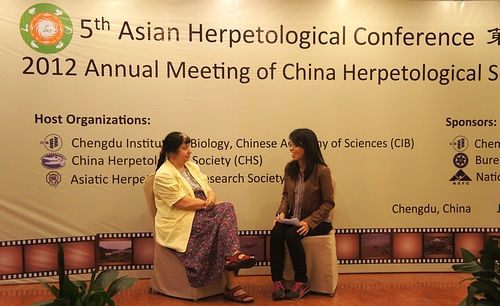
Interview 2 Video webiste: http://vod.cas.cn/vod_cib_cas/CIBV/201206/t20120606_3593118.html
Interviewer: Megan Li
Interviewee: Professor Natalia B. Ananjeva
Interviewer: Today, I am honored with Dr. Natalia Ananjeva from the Russian Academy of Sciences. I am very honored to have her with us. I hope you don’t mind if I ask you a few questions? So what are your impressions of the conference so far?
Ananjeva: I think it is very successful for herpetologists from many countries, from different continents. It’s good, because in combination with meeting of the Asian Herpetological Society, because for me and other foreign participants can have correct, clear impressions about the level of Chinese herpetology.
Interviewer: So how would you evaluate the herpetological studies in China compared to maybe Russia or the west?
Anajeva: I think the level is good enough. What is most important is that it’s increasing. It’s becoming better and better. I have a chance to compare because my first visit was 20 years ago—the first Asian Herpetological Conference –participating in all Asian meetings and organized groups -- Turkmenistan, Kazakhstan, so I can compare. The level is high. I think it’s very promising and prospective. So many people are very interested in herpetology, they are very enthusiastic, they try to know more and more. And they have the possibility because this is the home of this country –China itself is very rich and there are many fields to study from. Of course, it is very important. They use so many different methods, and the harmonization of approaches and methods is quite high.
Interviewer: So you say that you were here 20 years ago. You must have collaborated with Chinese and Asian herpetologists—
Ananjeva: True, true.
Interviewer: How would you describe your history with Asian herpetologists?
Ananjeva: My first visit was 20 years ago and we worked in a “triangle” combination, with United States and Chinese herpetologists to study in the territory of the former Soviet Union and China in accordance with herpetologists from the United States or Australia. This gave us high expertise on a professional level. We also have a joint program in faunistics because we [share] one fauna. So we need to study together, in Russia and the former Soviet Union…I worked in all these institutes in Russia and they have stored the most important collection which makes it necessary to work with many groups. And our colleagues in China, we have made many fruitful collaborations and cooperation with joint work, discussion. And I hope for future projects.
Interviewer: How do you meet new Chinese herpetologists? Do you read their publications or…have you met any at the conference?
Ananjeva: Of course. I read the publications, and 20 years ago, I met with many of them. Professor Zhou Ermi visited with us earlier at our Institute and I’ve met with his students who are now professors.
Interviewer: What talks have really interested you at this conference?
Ananjeva: Because I am interested most in phylogeny and biodiversity studies, of course I found these talks to be most interesting…
Interviewer: Well, speaking of biodiversity, what do you think is the major problem facing reptiles and amphibians?
Ananjeva: The same with all organisms: Destruction of habitat. Of course, they’re declining and it’s very dangerous.
Interviewer: One more question. What do you think of young herpetologists, now that you’ve met some?
Ananjeva: They’re very enthusiastic! They’re very open for different knowledges and they’re very open for collaboration. And I think they’re the future…I hope that in ten years we shall see what kind of professors and experts we’ll have.
Interviewer: That’s great to know. I’m really honored that you could be with us today and I hope you’ve been enjoying Chengdu so far.
Ananjeva: Thank you! It’s been my pleasure. The country is wonderful.