In this study, Prof.SHAO Huawu's team from Chengdu Institute of Biology described a simple and one-pot approach for the synthesis of
water-soluble F-AuNPs with a large Stokes shift and high quantum yield, protected by
11-mercaptoundecanoic acid (11-MUA), by the
reduction of Au
3+ with
NaBH4 in
methanol solutions. The synthetic F-AuNPs have a high quantum yield, large Stokes shift and good photostability.
Researchers synthesized three different ligand modified
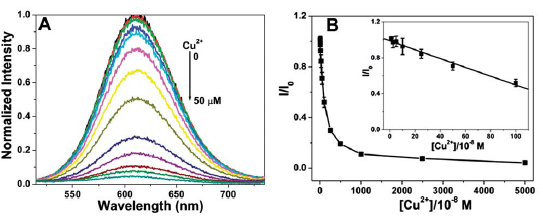
gold nanoparticles , and found that the fluorescence intensity was dependent on the length of different ligands. Meanwhile, this kind of F-AuNPs could detect
copper ions with good sensitivity and selectivity in aqueous solution with the obvious quench of fluorescence.
Since
Cu2+ plays important roles in various
biological processes ,it is however toxic at high concentration, and can cause liver or kidney damage. Therefore, assay for
copper ions in aqueous solution is critical. Due to the excellent photostability and high quantum yield, the F-AuNPs are suitable to build a sensing system.
A simple and one-pot method for the synthesis of water-soluble, red-emitting, highly fluorescent gold nanoparticles has been reported using 11-mercaptoundecanoic acid (11-MUA) as the protecting group . Researchers found that the fluorescent gold nanoparticles could selectively detect copper ions in aqueous solution, with a limit of detection of about 87 nM.