Various polymeric amphiphiles have achieved increasing attention due to their special physicochemical and morphological properties in water. Through non-covalent association arising from intra- and/or inter-molecular interactions among hydrophobic segments in the aqueous medium, these polymeric amphiphiles consisting of hydrophilic and hydrophobic segments can form micelle or micelle-like self-aggregates with hydrophobic cores and hydrophilic shells.
Because these self-aggregates have potential uses in biotechnology and medicine fields due to their unique supramolecular structures, many polymeric amphiphiles have been explored, and their physicochemical properties also have been widely investigated.
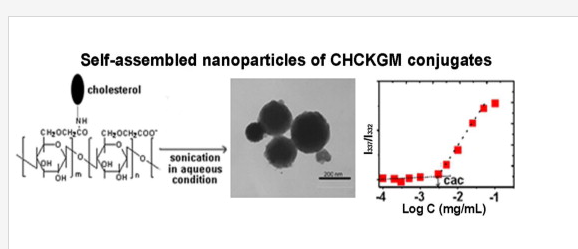
Various cholesterol (CH) bearing carboxymethyl konjac glucomannan (CKGM) amphiphilic conjugates (denoted CHCKGM) were synthesized using CKGM as hydrophilic segments and CH as hydrophobic parts. Structural characteristics of these CHCKGM conjugates were investigated using FTIR, 1H NMR and thermogravimetric analysis (TGA).
The properties of these self-aggregates were analysed by dynamic laser light-scattering (DLS), zeta potential, transmission electron microscopy (TEM) and the fluorescence probe technologies. The critical aggregation concentration (cac) of CHCKGM conjugates (2.59 × 10⁻³ to 5.89 × 10⁻³ mg/mL) was comparatively low, suggesting that the cholesterol fragment was very effective for forming aggregates.
Etoposide was physically entrapped into the CHCKGM nanoparticles by sonication method. The in vitro release behavior of etoposide from CHCKGM nanoparticles revealed a sustained release property. Furthermore, these self-aggregated nanoparticles showed pH- and ionic strength-dependent properties which caused a considerable change in their radius.
Researchers from Chengdu Institute of Biology and Sichuan University cooperated to study this job.